


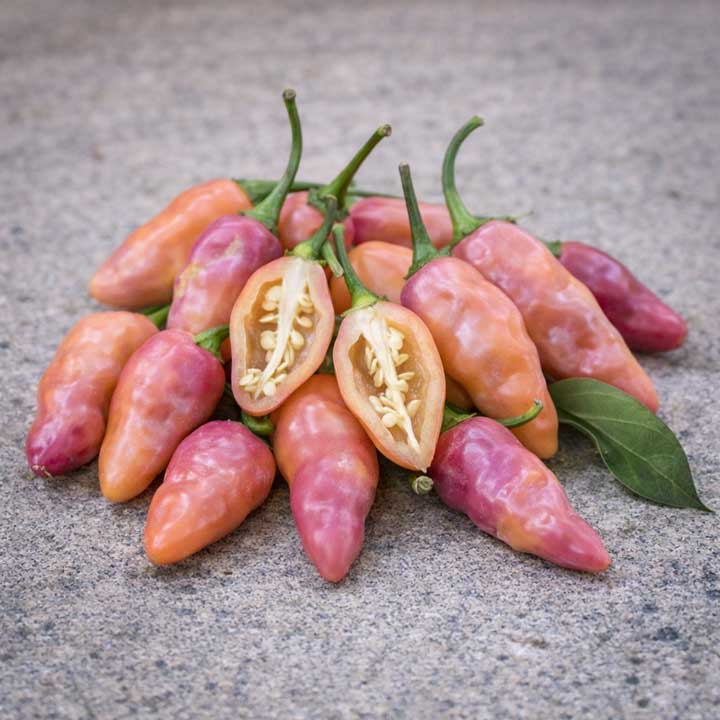
Fidalgo Roxa – a ‘candy chilli’ from Brazil with a purple start and a rosy finale
What makes Fidalgo Roxa special
Fidalgo Roxa is a chilli that tends to make people smile a little when the plant starts to bear – because it looks almost as if someone had hung little sweets in the bush. The pods are small, lantern-/acorn-shaped and change colour in several steps: often from dark purple (sometimes almost black in the right light) to pink/peach/salmon tones as they ripen. Add white-purple flowers and darker stems on some plants, and you have a variety that is both ornamental and fully serious in the kitchen.
This is a chilli for anyone who wants to grow something beautiful – but who also wants to use the harvest for more than ‘look and smile’.
Background and name
Fidalgo Roxa comes from Brazil, and ‘roxa’ refers to the purple colour range (Portuguese ‘roxo/roxa’ is often used for purple). It is also often mentioned as part of a small group of Brazilian ‘Roxa’ types, where the visual expression is a big part of the charm: dark tones at the unripe stage and a really nice, paler ripening colour that makes the pods stand out on the plant.
Appearance and growth habit
Fidalgo Roxa is a Capsicum chinense that often becomes bushy and productive once it has got going. In a pot it often ends up around 60–100 cm depending on season, pot size and how much light/warmth it gets. It can be a little slow to start (classic chinense), but once it gets going it usually delivers many pods.
The pods are usually 2–4 cm, often like little lanterns/acorns, sometimes a bit more elongated depending on seed line. The colour change is the ‘main act’:
-
unripe pods: purple/dark purple (sometimes with green touches)
-
ripe pods: pink/peach/salmon/rose tones, sometimes with paler streaks
It is the kind of variety you like to have where you see it often – because it keeps changing.
Estimated Scoville heat
Fidalgo Roxa is often given as medium-hot to hot, but the strength can vary clearly between seed lines and growing conditions. A reasonable range to count on is roughly 50,000–100,000 SHU.
In practice that means: it is usually stronger than a ‘mild cooking chilli’, but seldom in the super-hot class. Perfect when you want clear heat without everything having to be about survival.
Flavour and uses
Flavour-wise Fidalgo Roxa often lands in that nice chinense bracket: fruity and aromatic, but not as ‘perfume bomb’ as some habanero-heavy varieties can be. It does really well when you want to build flavour with a clear heat you can feel – but still let the food be food.
It suits especially well for:
-
hot sauces (preferably with fruit or berries to play with the aroma)
-
pickling and preserving (nice colour and a good sting)
-
drying and powder (small pods, easy to handle, good results)
-
stews and slow cooking where you want an even, fruity warmth
Ways to use Fidalgo Roxa
An easy way to make friends with Fidalgo Roxa is to think ‘building block’ rather than ‘hand grenade’. Chop a little at a time and taste, especially if you are making sauce. And if you like making powder: dry the pods thoroughly and grind – you get a spice that gives both heat and a little aromatic twist.
If you want to geek out a bit extra you can also harvest at different stages. Unripe purple pods are fantastically good-looking in a jar (think pickles), while fully ripe pink/peach pods often feel rounder in flavour.
How to grow Fidalgo Roxa
Fidalgo Roxa belongs to the species Capsicum chinense.
Sowing time: January – March (slow, heat-demanding).
Sow early and give the seeds steady warmth – chinense can take a little longer both to germinate and to get going. Once the plant is under way it wants plenty of light and preferably a slightly larger pot to produce generously. If you grow indoors, a little help with pollination (a gentle shake of the plant when it flowers) can give better fruit set.
Fidalgo Roxa is a variety that rewards patience: first you wait a bit… and then you are sitting there with a bush full of little ‘candy chillies’ that also taste the way they look.
The price is for 6 chilli seeds
Sow in moist seed compost and keep warm, at about 25–30°C for best germination The compost should be moist but not wet. A propagator helps to keep the air humid. Once the seedlings have grown a little and developed their second pair of leaves, you can lower the temperature to about 20°C and take them out of the propagator. They do well on a sunny windowsill, in a greenhouse and outdoors in summer. For best results, soak the seeds in Growhelper for 12–24 hours before sowing.


