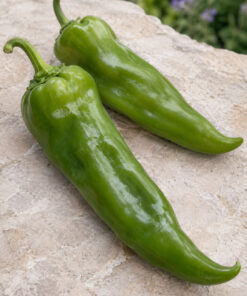



Tricolor – the splash of colour that delivers: variegated foliage and pods in several shades
What makes Tricolor special
Tricolor chilli seeds are the choice for anyone who wants to grow a chilli that looks like a little firework in a pot. This is a decorative but fully edible variety where both foliage and pods can be variegated – that is, patterned in several colours at once. You can get a plant with green foliage broken up with white touches, and pods that show off a proper play of colour during ripening: often purple, pink, green and paler streaks – before landing in red when fully ripe.
The nice thing about Tricolor is that it is not just ‘nice to look at’. It often gives plenty of pods, and the heat is clear enough to work in cooking, pickles and above all drying.
Background and name
Tricolor is often sold in the seed world as an ornamental/pot chilli with a focus on colour variation. The name refers to the classic ‘three-colour’ idea, but in practice the variety can show more shades than that depending on light, temperature and the exact seed line. It is also a variety where the expression can vary a little more than in completely ‘flat’ standard varieties – and that is actually part of the charm: each plant can get its own little pattern.
Appearance and growth habit
Tricolor belongs to the species Capsicum annuum, which usually means a faster start and a relatively easy-to-grow plant. It usually becomes compact to medium-tall, about 40–80 cm depending on pot, feed and season. Many grow it in a pot precisely because it stays neat and tidy, while it can bear fruit for a long time.
The pods are usually small to medium-sized, often elongated/conical or slightly ‘bullet’-shaped. A big part of the experience is the ripening journey: the pods can be dark purple early, get paler patterns or streaks, and finally ripen to red. The plant can often carry pods at several stages at once, which makes it look ‘pre-decorated’.
Estimated Scoville heat
Tricolor is often given as a chilli with clear heat, but exact figures can differ between seed lines. A reasonable level to count on is roughly 30,000–60,000 SHU, which places it in the category:
Heat class Medium-hot
Some descriptions mention higher levels, but in practice Tricolor is usually experienced as a stable medium-hot chilli that suits well when you want ‘real chilli heat’ without moving into very hot or super-hot.
Flavour and uses
Tricolor is more ‘classic annuum’ in flavour than a fruity chinense: clean chilli aroma, a slightly peppery note and a heat that arrives fairly quickly. It is not the most complex flavour in the world – but it is very useful, especially when you want a chilli that does the job without changing the flavour profile of the whole dish.
It suits particularly well for:
-
drying into flakes or powder (it really does well here)
-
chilli oil (moderate heat + a good ‘peppery’ note)
-
pickles and preserves (and yes: it looks fantastic in a jar)
-
everyday food where you want to dose easily
Ways to use Tricolor
Tricolor is the kind of chilli that becomes a favourite on the spice rack if you dry it. Dry the pods thoroughly and crumble them as flakes – you get a ‘standard chilli’ with good punch that suits everything from pizza to pasta and stews.
If you want extra colour and looks in your pickles you can pick some pods while they still have some of their dark/purple tones, and mix them with fully ripe reds. It is both good-looking and practical.
How to grow Tricolor
Tricolor belongs to the species Capsicum annuum.
Sowing time: February – April.
Sow your chilli seeds indoors and give the plants plenty of light early, so they become compact and attractive. Tricolor does excellently in a pot, both in a greenhouse and on a warm, sheltered patio. To bring out plenty of colour in foliage and pods, strong light usually makes a big difference. Harvest continuously and the plant will keep flowering and setting new fruit.
This is simply a chilli that gives maximum growing pleasure per square centimetre – and a harvest you actually use.
The price is for 6 chilli seeds
Sow in moist seed compost and keep warm, at about 25–30°C for best germination The compost should be moist but not wet. A propagator helps to keep the air humid. Once the seedlings have grown a little and developed their second pair of leaves, you can lower the temperature to about 20°C and take them out of the propagator. They do well on a sunny windowsill, in a greenhouse and outdoors in summer. For best results, soak the seeds in Growhelper for 12–24 hours before sowing.