

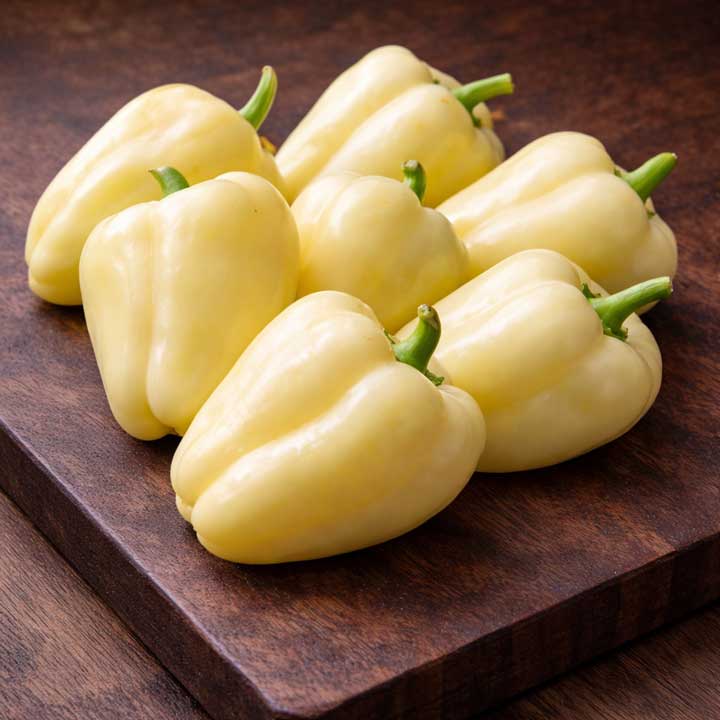
Zorza Sweet Pepper – an early, creamy white pepper that ripens red and loves being stuffed
What makes Zorza Sweet Pepper special
Zorza Sweet Pepper is the kind of variety that quickly becomes an ‘everyday lifesaver’ in the garden – not because it is dramatic, but because it simply delivers. It is very early, the plant stays compact and the pods are perfect when you want to grow sweet peppers that actually end up on the plate (and don’t just remain a nice idea in July).
What makes Zorza extra fun is that it is useful at several stages. The pods are often creamy white/pale yellow when unripe – and already then they are really nice to use, especially for stuffed peppers. If you let them ripen fully the colour moves on to orange-red and finally red, with more sweetness and depth of flavour.
Yes, this is sweet pepper rather than ‘chilli-chilli’ – but it is grown from sweet pepper seeds and belongs to the genus Capsicum, and it fits perfectly in a ChiliLovers shop for anyone who wants to broaden their growing with something the whole household dares to eat.
Background and name
Zorza is an established sweet pepper variety (Capsicum annuum) often highlighted for its earliness and practical habit. The name appears in several seed lines/markets, but the hallmarks are the same: a low, stable plant and pods that are pale when unripe and turn red at full ripeness.
It is a variety clearly developed for the needs of the kitchen: it should be easy to grow, give fruit early and work well both fresh and cooked.
Appearance and growth habit
Zorza Sweet Pepper belongs to Capsicum annuum and often grows into a low, sturdy plant, about 40–50 cm tall. A big bonus is that it usually has strong, stiff main stems, which means it often manages without support even when carrying fruit.
The pods are usually conical with a blunt tip, in a good size for cooking – often around 100–130 g. The colour change is typical of the variety:
-
unripe: creamy white/pale yellow
-
later ripeness: orange-red
-
fully ripe: red
That means the plant can be full of ‘shades’ at once, which also looks rather nice in the greenhouse.
Estimated Scoville heat
Zorza Sweet Pepper is a sweet pepper and normally has 0–500 SHU (in practice no heat).
Heat class: Mild
This is the variety you grow when you want flavour, juiciness and sweetness – not strength.
Flavour and uses
The flavour is classically sweet-pepper sweet and juicy, with a mild, rounded character. At the creamy white/pale yellow stage the flavour is often a little fresher and ‘greener’, while the ripe red pod usually gives more sweetness and fullness.
Zorza suits especially well for:
-
stuffed peppers (the variety’s showpiece)
-
oven-baked dishes and gratins
-
salads and raw vegetable platters
-
fried pepper dishes, pasta and tomato-based sauces
Ways to use Zorza Sweet Pepper
If you want to use Zorza in the smartest way: harvest some pods creamy white and use them for stuffed peppers. They are often a good size and shape and hold together nicely in the oven. Then let a few pods ripen fully to red when you want more sweetness – they are brilliant roasted, blended into sauces or simply sliced straight into a salad.
A little bonus in the kitchen is that Zorza is often experienced as ‘gentle’ even by those who are otherwise sceptical about peppers: mild flavour, juicy texture and nothing that causes trouble.
How to grow Zorza Sweet Pepper
Zorza Sweet Pepper belongs to the species Capsicum annuum.
Sowing time: February – April.
Sow your seeds indoors, preferably early in the period if you want an extra early harvest. Give the plants plenty of light from the start so they become compact and stable. Zorza does excellently in a pot and suits a greenhouse well, but can also work outdoors in a really warm and sheltered spot. Keep the compost evenly moist (not wet) and feed when the plant starts to set fruit – it usually responds by continuing to produce nicely over the season.
The price is for 6 sweet pepper seeds
Sow in moist seed compost and keep warm, at about 25–30°C for best germination The compost should be moist but not wet. A propagator helps to keep the air humid. Once the seedlings have grown a little and developed their second pair of leaves, you can lower the temperature to about 20°C and take them out of the propagator. They do well on a sunny windowsill, in a greenhouse and outdoors in summer. For best results, soak the seeds in Growhelper for 12–24 hours before sowing.


